Rspack Unveiled: How This Rust-Based Bundler Outperforms Webpack by 10x
If your Webpack builds feel slower than a sleepy sloth, Rspack might be the caffeine boost you need. Built in Rust and drop-in compatible with Webpack, it promises 10x faster builds—but does it deliver? Let’s dive in.
What is Rspack?
Rspack is a Rust-based JavaScript bundler designed as a drop-in replacement for Webpack. It leverages Rust’s performance, concurrency, and safety features to deliver exceptional speed, making it an ideal choice for projects where build performance is critical. Unlike Webpack, which is written in JavaScript and constrained by its single-threaded nature, Rspack taps into Rust’s capabilities to parallelize tasks, significantly reducing build times.
Beyond speed, Rspack maintains strong compatibility with Webpack’s plugins, loaders, and configuration, easing the transition for existing projects.
Getting Started with Rspack
Migrating from Webpack to Rspack is straightforward due to their similar configuration formats. Here’s a basic Rspack configuration file:
// rspack.config.js
const path = require("path");

module.exports = {
  entry: "./src/index.js",
  output: {
    path: path.resolve(__dirname, "dist"),
    filename: "bundle.js",
  },
  module: {
    rules: [
      {
        test: /\.tsx?$/,
        use: "builtin:swc-loader",
      },
    ],
  },
};
This configuration:
- Sets an entry point for your application
- Defines the output location and filename
- Configures TypeScript handling using the built-in SWC loader
To use this configuration, install Rspack with npm install -D @rspack/cli and run it with npx rspack.
Why Rust?
Rust’s adoption in Rspack isn’t arbitrary—it’s a strategic choice driven by the language’s strengths:
- Performance: Rust compiles to highly optimized machine code, enabling Rspack to process files faster than JavaScript-based tools.
- Concurrency: Rust’s robust support for parallel processing allows Rspack to handle multiple files simultaneously, a key factor in its speed advantage.
- Safety: Rust’s memory safety guarantees reduce runtime errors, ensuring a stable build process even under heavy loads.
By harnessing these qualities, Rspack redefines what’s possible in a bundler, offering a modern alternative to tools that have dominated the ecosystem for years.
Technical Diagram: Rspack Architecture
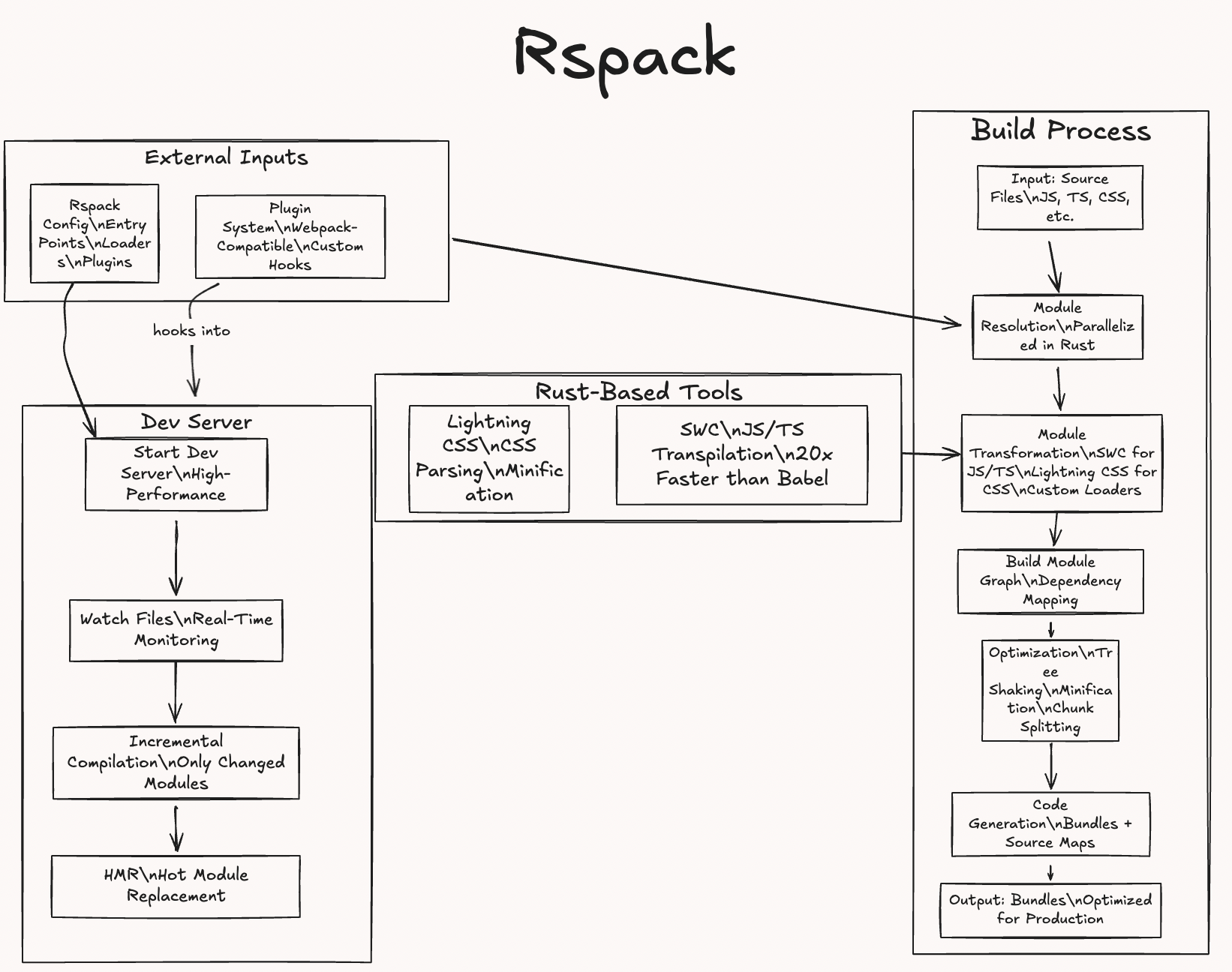
Rspack's parallel processing architecture showing module resolution, transformation, and bundling processes
Rspack’s Architecture: The Build Process
At its core, Rspack’s architecture is engineered for efficiency and flexibility. Its build process can be broken down into distinct stages, each optimized for performance:
1. Module Resolution
Rspack starts by reading the entry points defined in its configuration file (similar to Webpack’s entry field). It resolves all dependencies—whether ES modules, CommonJS, or other formats—constructing a module graph. This graph maps out how modules depend on one another, forming the foundation for subsequent steps.
2. Module Transformation
Next, Rspack transforms the resolved modules using a loader system. Loaders process files based on their type:
- JavaScript/TypeScript: Rspack uses its builtin:swc-loader, powered by SWC (Speedy Web Compiler), a Rust-based tool that transpiles and minifies code significantly faster than Babel.
- CSS: Processed via Lightning CSS, a high-performance Rust-based CSS parser and minifier.
- Custom Loaders: For compatibility, Rspack supports Webpack loaders (e.g., sass-loader, babel-loader), allowing developers to reuse existing setups.
This stage handles tasks like compiling TypeScript to JavaScript, converting Sass to CSS, or bundling assets like images.
3. Optimization
Rspack then optimizes the module graph:
- Tree Shaking: Removes unused code to reduce bundle size, leveraging the module graph to identify dead code paths.
- Minification: Compresses JavaScript with SWC and CSS with Lightning CSS, ensuring compact output.
- Chunking: Splits code into multiple bundles (e.g., for dynamic imports), optimizing load times.
These optimizations are performed in parallel, capitalizing on Rust’s concurrency features.
4. Code Generation
Finally, Rspack generates the output:
- Bundles: Single or multi-chunk files tailored to the configuration.
- Source Maps: Optional mappings for debugging, generated efficiently alongside the bundles.
The entire process is parallelized, with Rust’s threading capabilities ensuring that tasks like resolution, transformation, and optimization run concurrently where possible.
Key Features and Optimizations
Rspack’s performance isn’t just about raw speed—it’s backed by thoughtful features that enhance both development and production workflows:
Incremental Compilation and Hot Module Replacement (HMR)
Rspack’s incremental compilation mechanism rebuilds only the modules affected by changes, rather than the entire project. This powers its Hot Module Replacement (HMR) system, where code updates are applied in real-time without a full page reload. For large projects, this results in near-instant feedback, a stark improvement over Webpack’s often sluggish HMR.
Integration with High-Performance Tools
Rspack integrates seamlessly with Rust-based tools:
- SWC: Replaces Babel for JavaScript and TypeScript transpilation, offering up to 20x faster performance in benchmarks.
- Lightning CSS: Handles CSS parsing, transformation, and minification with exceptional speed and advanced features like nesting and vendor prefixing.
These integrations ensure that every step of the build pipeline is optimized.
Module Federation Support
Rspack provides first-class support for Module Federation, a Webpack feature that enables code sharing between applications. This is invaluable for micro-frontends and large-scale systems, allowing developers to build distributed architectures with ease.
Plugin and Loader Compatibility
Rspack’s compatibility with the Webpack ecosystem is a standout feature. Most Webpack plugins and loaders work out of the box, and its plugin system mirrors Webpack’s hook-based architecture, allowing developers to extend functionality as needed. Rspack also introduces built-in loaders (e.g., builtin:swc-loader) to bypass traditional loader overhead for common tasks.
Lazy Compilation
Introduced in later updates, lazy compilation delays the processing of certain modules until they’re requested, improving initial build times—a boon for development workflows with large codebases.
Performance Benchmarks
Rspack’s speed claims aren’t just marketing hype—they’re backed by comprehensive benchmarks comparing the major build tools. The following data shows performance across key metrics:
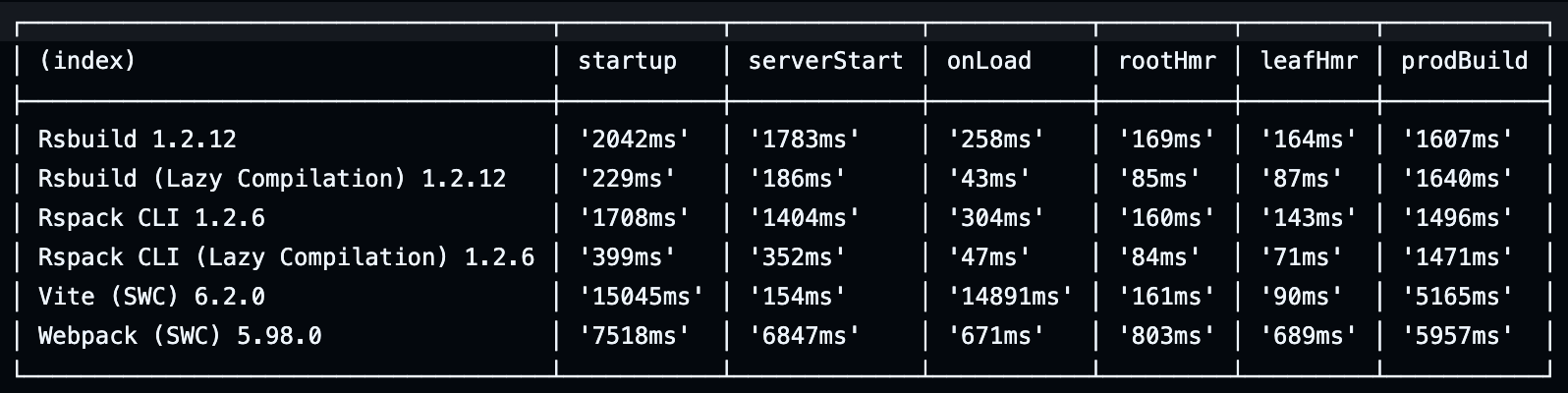
Benchmark comparing Rspack, Rsbuild, Webpack, and Vite across various metrics. Tests run on GitHub Actions (macOS 15) with 1000-5000 components and modules. Source: rspack-contrib/build-tools-performance
These results demonstrate Rspack’s significant advantages:
- 4.4x faster startup than Webpack (1708ms vs 7518ms)
- 4.8x faster server start than Webpack (1404ms vs 6847ms)
- 4.0x faster production builds than Webpack (1496ms vs 5957ms)
- Nearly 19x faster startup with lazy compilation enabled (399ms vs 7518ms)
With lazy compilation enabled, both Rspack and Rsbuild (based on Rspack) deliver near-instantaneous development experiences. For large projects, these performance gains translate to significantly improved developer productivity and CI/CD efficiency.
The Dev Server: A Developer’s Dream
Rspack’s development server is a high-performance companion to its build process. It:
- Watches for file changes.
- Triggers incremental compilation.
- Applies updates via HMR.
This ensures a smooth, real-time development experience, even for complex applications.
Why Rspack Matters
Rspack isn’t just a faster Webpack—it’s a reimagining of what a bundler can be. Its Rust-based architecture, parallel processing, and integration with cutting-edge tools set a new standard for performance. Meanwhile, its Webpack compatibility ensures it fits into existing workflows, reducing adoption friction.
For developers tackling large-scale projects, Rspack eliminates build-time bottlenecks, enabling faster iteration and deployment. Its support for modern features like Module Federation and lazy compilation positions it as a future-proof choice in a rapidly changing ecosystem.